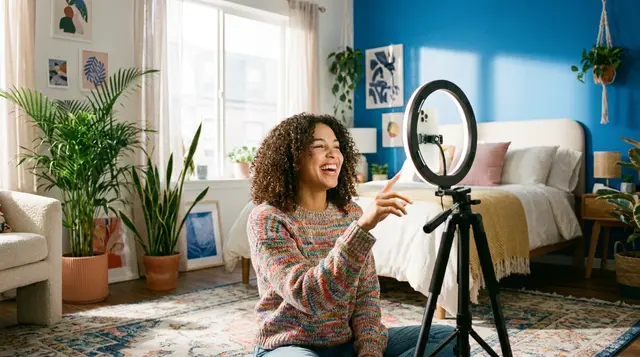
Yapping is unscripted, barely edited video where you talk straight to camera about one idea. No script, no hook formula read off a card, no production. It wins in 2026 for a mechanical reason rather than an aesthetic one: it holds average watch time, and watch time is one of the three signals Instagram’s head has actually confirmed matter most for ranking.
The format also arrived at the right moment culturally. Feeds filled with polished, generated and near-identical content, and a video that sounds like a person talking became the thing that stands out.
This article covers what yapping is and is not, the two reasons it ranks, why it is a skill rather than an absence of one, who it suits, and how to start without producing twenty minutes of nothing.
Key Takeaways
- Watch time, likes and sends are the three ranking signals Instagram’s head has confirmed (as stated by Adam Mosseri, January 2025).
- Yapping optimises for average watch time, which suits the format better than completion-rate thinking does.
- It is a skill, not the absence of one. Energy, rhythm and a single clear idea separate a yap that spreads from one that dies at 200 views.
- Keep it under three minutes if you want it recommended to people who do not follow you (socialpilot.co, 2026).
- It is the cheapest format to test and the most expensive to fake, because personality is the only input.
What yapping actually is
A single person, a phone, and one idea talked through in a relaxed register. Minimal edits. No B-roll obligation. The energy of a voice note to a friend rather than a piece to camera.
The subgenre descriptions converge on the same traits: direct address, low pressure, no corporate polish, no hype voice (quasa.io and sociallama.pl, 2026). The point is that it reads as a video from a person rather than an ad.
What it is not: rambling with no destination. The loosest-feeling yaps still have one idea and a reason to keep listening. A video with no point does not hold watch time, and watch time is the entire mechanism.
Why it ranks: the two reasons
Reason one is watch time. Instagram’s head has named the top three signals as watch time, likes and sends. A talking-head video where the value arrives continuously, rather than in a punchline at the end, holds attention across the middle. That is what average watch time measures.
The shift away from pure completion-rate thinking matters here. Platforms lengthened their maximum runtimes and weight average watch time, which rewards a format that can be two minutes long and still hold (quasa.io, 2026). A fifteen-second video has to be perfect to score; a ninety-second one has more room to accumulate watched seconds.
Reason two is scarcity. Feeds are full of content that looks produced and sounds generic. A format whose entire input is a specific person talking is the one thing that cannot be mass-produced, which is why it reads as credible. Personal branding for creators covers the longer version of that argument.
It is a skill
The format’s reputation as effortless is the reason most attempts fail.
Holding attention through tone, rhythm and energy with no edit to hide behind is harder than cutting a tight fifteen-second clip. The things that separate a yap that spreads from one that dies: a first line that states what this is about, a pace that does not sag in the middle, and a reason for the specific person on screen to be the one saying it.
| Produced short video | A yap | |
|---|---|---|
| Edit time | High | Near zero |
| What carries it | Cuts, music, text, B-roll | Voice, pace, a single idea |
| Best length | 15 to 30 seconds | 45 seconds to 3 minutes |
| Scores on | Completion rate | Average watch time |
| Fails when | The hook misses | The middle sags |
| Reproducible by anyone else | Yes | No |
The last row is the whole commercial argument. Anybody can copy your edit. Nobody can copy how you talk.
Who it suits
Anyone with an opinion and a specialism. Yapping sells a point of view, so it needs you to have one.
Service providers and coaches. The format demonstrates how you think, which is what the buyer is actually assessing.
Creators whose production time is the bottleneck. If editing is why you post twice a month, this is the format that unblocks you.
It suits product demonstration less well. If the value is in seeing the thing, show the thing. Format follows the job.
How to start
Five constraints, which exist to stop the two failure modes: no point, and no end.
- One idea per video. Write it as a sentence first. If you cannot, you are not ready to record.
- Say what it is in the first line. Not a cliffhanger, a subject. Hook ideas for creators covers the openers that work without sounding like a template.
- Record in one take, keep the second attempt. The first is nerves and the third is a performance.
- Stay under three minutes. Reels over three minutes do not get recommended to new audiences (socialpilot.co, 2026). The technical ceiling is much higher and irrelevant.
- Finish with one thing to do. The format’s weakness is drifting to a stop, which wastes every watched second you earned.
If your videos are getting few views regardless of format, the cause is usually upstream of the format itself and why your Reels get no views works through the common ones.
Where the traffic goes
A yap earns attention and then has to spend it somewhere.
The format’s weakness is that the call to action is spoken, not tappable. Someone hears “the template is on my page”, opens your profile, and whatever they find there decides whether the watched minute converts. A page that answers them in one screen pays off attention the video earned; a flat list of twenty untitled buttons loses it.
A More.You page handles the other half of this: the newest thing you mentioned can auto-pin to the top for a set number of hours when a scheduled post goes live, and click attribution tells you which video drove which clicks. Create your More.You page so the attention a yap earns lands somewhere that converts it.
FAQ
What does yapping mean on social media?
Unscripted, minimally edited video where a creator talks directly to camera about one idea, in a relaxed register with no production polish (quasa.io, 2026).
Why does yapping get more reach than edited videos?
It holds average watch time, and watch time is one of the three ranking signals Instagram’s head has confirmed, alongside likes and sends. Longer talking-head videos accumulate watched seconds in a way short, punchline-driven clips cannot.
How long should a yap be?
Between about 45 seconds and three minutes. Staying under three minutes keeps the Reel eligible for recommendation to people who do not follow you (socialpilot.co, 2026).
Is yapping just rambling?
No. The loose feel comes from the delivery, not the structure. A yap that works has one idea, states its subject early, keeps pace through the middle, and ends with something to do.
Does yapping work if I hate being on camera?
It is the hardest format for that, because the only input is you. Starting with audio-led formats or shorter pieces to camera builds the same muscle with less exposure.
Sources
- The yapping format, its traits and the shift from completion rate to average watch time (quasa.io, 2026)
- Format description and cultural context for unscripted talking-head video (sociallama.pl, 2026)
- The three-minute recommendation threshold for Reels (socialpilot.co, 2026)
- Watch time, likes and sends as the top-weighted ranking signals, as stated by Adam Mosseri, January 2025
- More.You product brief, docs/moreyou/01-product-brief.md, sections 2 and 3 (auto-pin, analytics, post attribution)