The Amazon Influencer Program is Amazon’s affiliate program for social media creators. Approved creators get a storefront page on Amazon with its own URL, earn a commission on qualifying purchases at rates set by product category, and can add shoppable photos and videos that Amazon may show on its own pages. It’s free to join, and Amazon reviews each application.
Getting approved is the first step. Your storefront lives on Amazon, your audience lives on Instagram or TikTok, and the link between them shares a bio with everything else you promote.
This guide covers how to qualify, how pay works under Amazon’s current rules, how it differs from Associates, and how to route traffic through a bio page with proper disclosure.
Key Takeaways
- It’s an extension of Amazon Associates, built for creators on YouTube, Instagram, TikTok, Pinterest and Facebook, with a storefront page added on top.
- Amazon publishes no follower minimum. It reviews content quality, engagement rate and follower count together.
- Offsite commission follows Amazon’s category rate card, from 10% on luxury beauty down to 1% on grocery and health, with some categories at 0%.
- The click window is 24 hours, extended to 89 days only when the shopper adds the product to their cart in that session.
- Disclosure goes next to the link, not only in your profile. Amazon accepts “(paid link)”, “#ad” or “#CommissionsEarned” on social.
What is the Amazon Influencer Program?
It’s an extension of Amazon Associates for creators who drive sales from social media. You get the Associates reporting and account tools, plus a storefront page on Amazon with a custom URL, Idea Lists to group products, and the option to upload shoppable photos and videos.
Amazon’s help center calls the storefront URL “especially useful when promoted verbally” (affiliate-program.amazon.com, November 2026), so you can say it out loud in a video. Storefront addresses follow an amazon.com/shop/ pattern with your name or handle (helium10.com, November 2026).
The shoppable content is the second income line. Amazon says photos and videos you add are eligible to appear across Amazon, including product pages, search results and the homepage (aboutamazon.com, September 2026).
Amazon Influencer Program requirements
You need a qualifying YouTube, Instagram, TikTok, Pinterest or Facebook account. Amazon reviews applicants on “content quality, engagement rate, and follower count” and lets creators who don’t qualify reapply later (aboutamazon.com, September 2026). There is no published follower number.
Associates rules bind you too. They bar any handle, domain or username that contains an Amazon trademark or a misspelling of one (Amazon Associates Program Policies, November 2026). They also bar buying through your own links or asking friends and family to do it.
How to apply
- Sign in at affiliate-program.amazon.com/influencers with your Amazon account.
- Connect the social account with your strongest engagement, not your biggest following.
- Once approved, set up your storefront and your first Idea Lists.
- Add tax and payment details in Associates Central so commission can pay out.
How does Amazon Influencer pay work?
You earn a commission on qualifying purchases made after a shopper clicks your link, at the rate Amazon sets for each product category. Payment arrives about 60 days after the end of the month in which you earned it (Amazon Associates Program Policies, November 2026). The US minimum to be paid is $10 for direct deposit or an Amazon gift card, and $100 for a check with a $15 processing fee (Amazon Associates Program Policies, November 2026). Your own rate card sits inside Associates Central and can change.
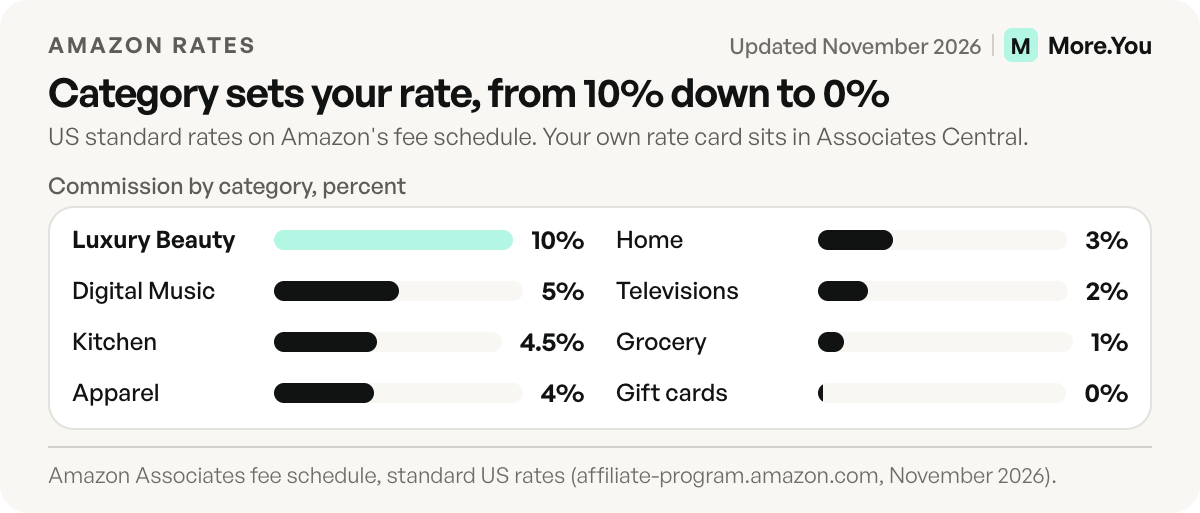
Here is a sample of the US standard rates from Amazon’s fee schedule (checked November 2026):
| Category | Standard (offsite) commission |
|---|---|
| Luxury Beauty | 10% |
| Digital Music, Handmade | 5% |
| Physical Books, Kitchen, Automotive | 4.5% |
| Apparel, Shoes, Jewelry, all other categories | 4% |
| Home, Toys, Beauty, Pets, Sports, Baby | 3% |
| Televisions | 2% |
| Grocery, Health and Personal Care | 1% |
| Gift cards, alcoholic beverages | 0% |
The 24-hour window and the 89-day cart rule
The click starts a session that ends after 24 hours, when the shopper places an order, or when they click another Associate’s link, whichever comes first. If the shopper adds the product to their cart during that session and buys within 89 days of the first click, you still earn (Amazon Associates Program Policies, November 2026).
The 180-day figure you may see quoted is a different clause. It is the deadline for the product to be shipped and paid for, not an attribution window.
Onsite commission is a separate stream
When Amazon uses your shoppable photos or videos on its own site, you earn “Onsite Commission Income” on top of your link sales. To earn it, you must register as an influencer with a dedicated Store ID for that purpose, and the rates sit in Associates Central (Amazon Associates Program Policies, November 2026). Published onsite rates from third parties conflict, so check yours in your account.
Amazon Associates vs Amazon Influencer: what’s the difference?
Associates is the base affiliate program for websites, apps and social accounts. The Influencer Program sits on top of it and adds the storefront and shoppable content. You can belong to both, and existing Associates apply for the influencer tools without a second account (affiliate-program.amazon.com, November 2026).
| Amazon Associates | Influencer Program | |
|---|---|---|
| Built for | Websites, apps, blogs and social accounts | Creators on YouTube, Instagram, TikTok, Pinterest, Facebook |
| How you qualify | Three qualifying sales within 180 days of applying, then review | Review of content quality, engagement rate and follower count |
| What you get | Special Links, reporting, account tools | Everything in Associates, plus a storefront URL, Idea Lists and shoppable content |
| Commission on link sales | Category rate card | Same category rate card |
| Extra income | None tied to Amazon-hosted content | Onsite commission when Amazon uses your content |
| Rules | Operating Agreement and Program Policies | The same, plus the Influencer Program Policy |
The qualifying-sales rule comes from Amazon’s own help page: after you apply, you have 180 days to refer three qualifying sales before Amazon evaluates the account (affiliate-program.amazon.com, November 2026). If your audience lives on video, the storefront is the reason to apply.
How to route storefront traffic from social through a bio page
Amazon’s help center answers the one-link problem itself. It recommends a link tool that houses all your links in one place, so your storefront, blog and other affiliate links sit together (affiliate-program.amazon.com, November 2026). That page is your bio page.
1. Label the Amazon link as Amazon
The policies forbid using a link shortener, button or hyperlink “in a manner that makes it unclear that you are linking to an Amazon Site” (Amazon Associates Program Policies, November 2026). Name the button “Shop my Amazon storefront”, not “My favorites”.
2. Put the disclosure next to the button
The FTC says a disclosure is “likely to be missed” if it appears only on a profile page (ftc.gov, November 2026). Its affiliate guidance adds that “paid link” right next to an affiliate link should be adequate (ftc.gov, November 2026). Amazon also requires the line “As an Amazon Associate I earn from qualifying purchases” on your Site (Amazon Associates Operating Agreement, November 2026). Amazon adds that for social media content the statement must be associated with your account. Put that line on the bio page and add “(paid link)”, “#ad” or “#CommissionsEarned” in each post that sends people there, the short forms Amazon names for social (affiliate-program.amazon.com, November 2026).
3. Link single products when one post sells one thing
The storefront suits browsers. A post about one blender should send people to that blender, because the 89-day extension only starts when the product reaches the cart. A products block for that item, pinned to the top while the post is fresh, removes a search step. Affiliate links in bio covers how to structure those blocks.
When people ask for the link in the comments, the answer can go by DM. CreatorFlow, built by the same team as More.You, sends your Amazon affiliate link by Instagram DM to everyone who comments your keyword. Name the store in that message too, so the link still reads as Amazon.
4. Keep the newest post’s product on top
Amazon traffic comes in spikes after each video. On More.You you can pin any link to the top by hand on the free plan, and Auto-Pin (Pro) does it for you when a scheduled post goes live, then removes it after 24 hours, 3 days or 7 days.
5. Measure which post sent the shoppers
Amazon reports orders, not the Reel that caused them. More.You’s free analytics show views, clicks and click-through rate per block, and attribution (Pro) ties each click to the post and platform that sent it. Post attribution for creators explains how to read that data next to your Amazon earnings.
The bio page has a second reader too. Every More.You page ships an llms.txt file and structured data built from its blocks, including Product data from product blocks, so AI assistants answering “what does this creator recommend” can read your picks.
Is the Amazon Influencer Program worth it?
It’s worth it if your audience already buys what you show, because modest rates reward volume. An illustrative example, not a measured result: a $40 kitchen item at the 4.5% Kitchen rate pays $1.80 per order. A $40 item in Home at 3% pays $1.20. At 100 orders a month, that is $180 against $120, so the category your audience buys from changes the result as much as the click count. If you also work with ShopMy or LTK, affiliate storefronts compared shows how the three differ on rates and approval, so you can decide which storefront gets the top spot on your page.
Your storefront lives on Amazon, but your audience arrives through your bio. Create your More.You page so people find the Amazon link, the disclosure and your latest pick in one place, and AI assistants can read it too.
Amazon rules that cause trouble, and the fix
- Buying through your own link. The policies forbid buying through your Special Links or asking others to. Buy through Amazon directly instead.
- Telling people to bookmark your link. This is not allowed. Send them to your bio page, which holds the link.
- A bio button that hides Amazon. Name the destination in the button text.
- No statement on the page. Add “As an Amazon Associate I earn from qualifying purchases” to the bio page, then use the short forms in posts.
- An idle account. Amazon says that if you earn no commission for three years, it may charge a maintenance fee of $10 or your unpaid commission, whichever is less, and may close the account for dormancy (Amazon help, affiliate-program.amazon.com, November 2026).
FAQ
How many followers do you need for the Amazon Influencer Program?
Amazon publishes no minimum. It reviews content quality, engagement rate and follower count together, and creators who are declined can apply again later.
Can you be in Amazon Associates and the Influencer Program at the same time?
Yes. The Influencer Program is an extension of Associates, so influencers hold an Associates account and follow the same Operating Agreement. Existing Associates can add the influencer tools without starting over.
How long does the Amazon affiliate cookie last?
The session lasts 24 hours from the click. If the shopper adds the product to their cart in that window, you earn on that product if they complete the order within 89 days of the first click.
Where do I put the Amazon disclosure on Instagram?
Put a short disclosure such as “(paid link)” or “#ad” in each post that promotes a product, near the call to action. Add the full Amazon statement to your bio page. A disclosure only in your profile is likely to be missed, according to the FTC.
Can I use a link shortener for my Amazon storefront link?
Only if it stays clear that the link goes to Amazon. The Associates policies ban shorteners and buttons that hide the Amazon destination.
Sources
- How the influencer program works (aboutamazon.com, September 2026)
- Amazon help: how the influencer program differs from Associates (affiliate-program.amazon.com, November 2026)
- Amazon Associates Program Policies: Participation Requirements, Commission Income Statement, Influencer Program Policy (affiliate-program.amazon.com, updated April 14, 2026, read November 2026)
- Amazon Associates Program Operating Agreement (affiliate-program.amazon.com, updated October 15, 2025, read November 2026)
- Amazon Associates account dormancy and qualifying sales (affiliate-program.amazon.com, November 2026)
- Amazon help: Instagram allows one link, what should I do? (affiliate-program.amazon.com, November 2026)
- Amazon help: identifying yourself as an Associate on social media (affiliate-program.amazon.com, November 2026)
- Disclosures 101 for Social Media Influencers (ftc.gov, November 2026)
- FTC Endorsement Guides: What People Are Asking (ftc.gov, November 2026)
- Amazon Associates fee schedule (affiliate-program.amazon.com, November 2026)
- Amazon influencer storefront URL format (helium10.com, November 2026)
- More.You features (more.you/features/auto-pin, more.you/features/analytics-attribution, more.you/features/ai-native-pages, November 2026)
Platform rules and prices checked November 2026.