Most influencers make less than $10,000 a year from content. In CreatorIQ’s 2026 survey of 5,095 creators, 67% earned under $10,000 and a little under 5% cleared $100,000. A US survey of 1,000 creators found 48.7% under $10,000. Per-post rates look much higher, but a rate is the price of one deal, and most creators don’t close many deals.
Rate cards say a micro creator charges a few hundred dollars per post. Income surveys say the typical creator earns less in a year than a part-time job. Both are true, because a rate card never says how many posts got sold.
This guide puts yearly income and per-post rates side by side, names every source and its sample, and ends with the part you control: the page where your product income happens.
Key Takeaways
- The typical influencer earns under $10,000 a year. 67% of 5,095 creators in CreatorIQ’s 2026 survey reported less than that, and 62% said content isn’t their main income.
- Averages hide the median. On CreatorIQ’s payment data for 2025, creators averaged $11.4k while the median creator earned $3.0k. The top 10% took 62% of all payments.
- Per-post rates disagree by up to 6x for the same tier. Two current rate guides put a micro Instagram post at $100 to $500+ and a micro Story at $500 to $3,000.
- Brand deals are one income line among several. In a 2026 US survey, product, merch and affiliate income together drew nearly as many answers as ad revenue as a top income source.
- The income you own runs through your bio link. Affiliate and product sales happen on the click, so the page that receives it decides how much of that income you keep and can prove.
How much do influencers make a year?
Roughly half to two thirds of surveyed influencers make under $10,000 a year, and about 5% make more than $100,000. That holds across the largest recent surveys, run by different companies with different samples. No public dataset covers every creator, so read who was asked before you read the income figures.
| Source | Who was asked | Under $10,000 | Over $100,000 |
|---|---|---|---|
| CreatorIQ and Influencers.club, State of Creators 2026 | 5,095 creators, May 29 to June 29, 2026 | 67% | Under 5% |
| The Influencer Marketing Factory, 2026 | 1,000 US creators aged 18 to 65, January 2026 | 48.7% | 5.7% |
| CreatorIQ and Sapio Research, 2025 | 300 creators | 18% | 11% |
| Goldman Sachs Research, 2023 | Global estimate | Not given | About 4% |
The 300-person CreatorIQ sample is the outlier, with an average reported income of $44,293. It is also the smallest sample in the table by a wide margin. The two larger 2026 surveys and the Goldman Sachs estimate land close together on the share above $100,000, at 4% to 5.7%.
The low figures have a fair caveat. In the 2026 CreatorIQ survey, 62% said content creation isn’t their primary source of income, so many respondents are part-timers. That doesn’t make the median wrong. It means “influencer” covers everyone from a hobbyist with 6,000 followers to a full-time studio.
What is the median influencer income?
The median influencer earns a fraction of the average. CreatorIQ’s December 2025 payment data covers 14.4k creators who received direct payments through its platform. They earned an average of $11.4k and a median of $3.0k, so the average sits nearly four times above the typical creator.
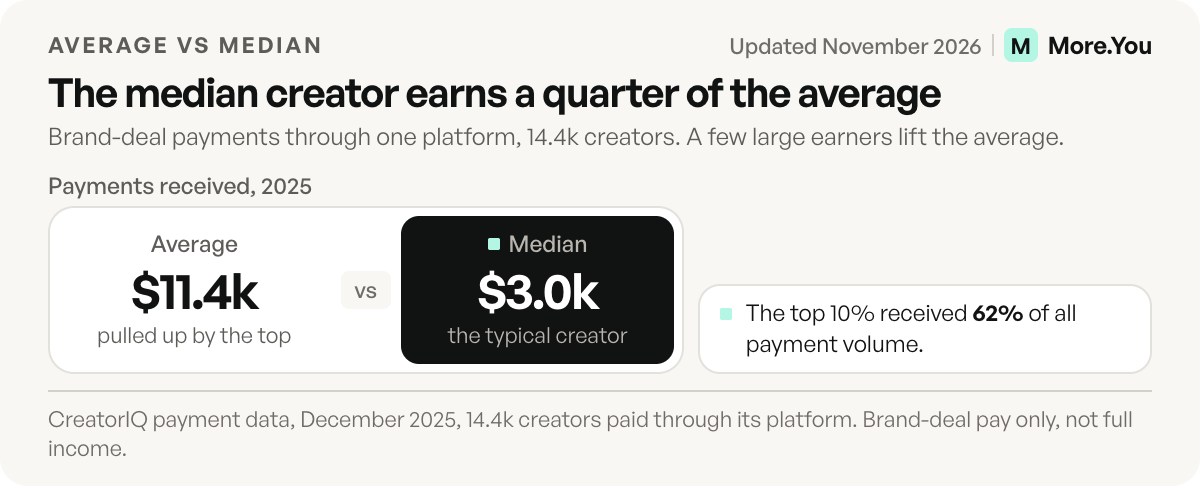
The same data shows where the money concentrates. The top 10% of creators received 62% of all payment volume, and the top 1% received 21%. Total dollars paid to creators grew 59% year over year, while the number of creators in campaigns grew 183%. More creators are splitting the budget, so the pie grew slower than the queue for it.
These figures count money paid through one company’s software, so read them as brand-deal pay, not full income.
How much do influencers make per post?
A micro influencer charges somewhere between $100 and $5,000 per Instagram post, depending on which guide you trust and which format the brand buys. That spread is the honest answer. Rate guides publish ranges, few publish a sample, and the same tier can differ by six times between two current sources.
| Tier (followers) | Influencer Marketing Hub, per sponsored post | Modash, US, Story / Reel |
|---|---|---|
| Nano (under 10,000) | $10 to $100+ | Not listed |
| Micro (10,000 to 100,000) | $100 to $500+ | $500 to $3,000 / $750 to $5,000 |
| Mid-tier (100,000 to 500,000) | $500 to $5,000+ | $2,000 to $10,000 / $5,000 to $20,000 |
| Macro (500,000 to 1M) | $5,000 to $10,000+ | $5,000 to $30,000 / $10,000 to $50,000 |
| Mega (1M+) | $10,000+ | $30,000+ / $50,000+ |
Influencer Marketing Hub calls its figures “planning benchmarks, not fixed Instagram rate cards” (updated October 2026). Modash gives no follower thresholds, so its rows sit against the Influencer Marketing Hub tiers here. Modash says its ranges are based on US pricing and mostly apply to home and lifestyle brands (February 2026). Neither page publishes a sample size.
Marketplace data pulls the number down further. Collabstr’s 2026 report, built on more than 21,000 collaborations (coverage of the report says the data covers 2025), puts the average Instagram collaboration at $214 asked and $193 paid. Across all platforms, 80% of its engagements cost under $300, and 2% cost more than $1,000.
Why is the median far below the headline rates?
A rate is a price. Income is price multiplied by how many deals you close, minus costs and tax. Rate tables stop at the price, and deal count is where most creators fall short. Creators in the 2026 CreatorIQ survey named a lack of consistent brand deals as the number one barrier to growing their business.
Here is the arithmetic at Collabstr’s $193 Instagram average. This is our own illustration, before any costs or tax:
| Deals per year | Gross income at $193 per deal |
|---|---|
| 12 (one a month) | $2,316 |
| 52 (one a week) | $10,036 |
| 104 (two a week) | $20,072 |
One deal a month leaves you inside the 67% bracket. One a week barely clears $10,000. If you want to raise the price side of the equation, a media kit with real audience numbers is what brands check before they agree to a rate. If deals already arrive, contracts, usage rights and invoicing decide how much of the agreed fee reaches your account.
How much do Instagram influencers make?
Instagram influencers earn mostly in proportion to reach. The average paid Instagram collaboration on Collabstr was $193 in its 2026 report. CreatorIQ found follower and subscriber counts have the strongest relationship with creator income across Instagram, YouTube and TikTok, and that views track income more closely than engagement does.
The link is real but loose. Net Influencer’s coverage of the CreatorIQ survey reports a Spearman rank correlation of 0.40 between Instagram follower count and annual income (August 2026). At 0.40, two accounts of the same size can earn far apart.
Views are where many accounts stall. HypeAuditor data in The Influencer Marketing Factory’s report shows 46.2% of US-focused Instagram creators get fewer than 1,000 views per post. A brand buying reach pays for views, so a large following with low views prices like a small one.
How many followers do you need to earn a living?
No follower count guarantees a living, but 100,000 is where the data starts to shift. In CreatorIQ’s 2026 survey, over half of creators with 100,001 to 500,000 followers said content is their primary source of income. Below that, most respondents earn their living elsewhere. For the Instagram follower minimums by program, see how many followers it takes to get paid on Instagram.
That is why income outside brand deals matters for smaller accounts. A creator with 15,000 engaged followers may not close a deal a month, but can sell a preset pack, earn affiliate commission or take bookings without waiting for a brand to say yes.
Which influencer niches pay the most?
No named survey with a stated method publishes influencer income by niche, so treat any ranked niche list as an estimate. Rate guides agree on direction: niches whose audiences make expensive purchases, like finance and software, quote higher than lifestyle content for the same reach. Modash says its US ranges mostly apply to home and lifestyle, and other niches may be higher. Price follows what a viewer is worth to the brand. If you want a niche number, ask three brands in your niche what they paid, or read the rate guide for your platform, and treat the answer as a planning figure rather than a promise.
How do you set your first rate as a smaller creator?
Start from the range for your tier, then adjust it with your own proof. For illustration, a creator with 20,000 followers sits in the micro tier, where Influencer Marketing Hub’s planning benchmark is $100 to $500+ per sponsored post. Collabstr’s average paid Instagram collaboration was $193.
Follow these steps:
- Pick a floor. Ask for a price you would accept ten times in a row, not a price you hope for once.
- Add your proof. Views per post and the share of clicks to your bio page matter more than follower count. Brands buy views.
- Quote a range. Give a base price and a price with usage rights, so the brand sees what extra rights cost.
- Track every answer. After five quotes, you know whether you price too high or too low.
Your media kit holds the proof, and pitching brands as a creator covers the first message.
Where does influencer money come from?
Brand deals get the headlines, but they are one income line among several. The Influencer Marketing Factory asked 1,000 US creators to name their top income sources in January 2026. The answers ranked like this, from a multi-select question:
| Income source | Share of answers |
|---|---|
| Ad revenue | 21.6% |
| Product or merch sales plus affiliate marketing | 21.2% |
| Creator payouts | 13.3% |
| Brand partnerships | 12.7% |
The same report found 24.4% of creators earn 0% to 10% of their income from brand deals. Ad revenue and creator payouts are set by the platform, which rented income from platform payouts covers in depth. Products and affiliate links are the line you set yourself: your price, your commission, your buyer. For the full menu, see creator income streams you can run from one bio.
How does owning your bio page help you keep more?
Product and affiliate income happens on a click, and on Instagram that click often starts at your bio link. If the page behind it is a list of unlabeled buttons, the buyer has to guess. If it shows the product, the price and the booking slot, the sale is one tap away.
On a More.You page, product, booking and event blocks sit together, and basic analytics show views, clicks and click-through rate per block on the Free plan. Attribution, on Pro, ties each click to the post that sent it. That is evidence you can show a brand: this Reel sent this many clicks to your shop.
The page also has a second reader. Product blocks generate structured data, and every page ships an llms.txt file, so an AI assistant asked what this creator sells has labelled products to read. Auto-Pin, on Pro, pins a scheduled post’s link to the top of the page when the post goes live.
Your earnings are set by deal count, reach and the offers you own. Create your More.You page and give the income you control a page people and AI can both read.
FAQ
How much do influencers with 10,000 followers make?
No public survey prints income for exactly 10,000 followers. Rate guides put a nano or entry micro Instagram post at $10 to $500, and in CreatorIQ’s 2026 survey 67% of all creators earned under $10,000 a year. At this size, a yearly total under $10,000 is the likely outcome.
Do influencers get paid per follower or per view?
Neither directly. Brands usually agree a flat fee per deal and base it on audience size and views. CreatorIQ found follower counts have the strongest link to income and views track income more closely than engagement. Platform payouts are a separate line with their own rules.
What percentage of influencers make over $100,000?
Between 4% and 6% in the larger recent sources. CreatorIQ’s 2026 survey of 5,095 creators put it at under 5%, The Influencer Marketing Factory’s 2026 US survey at 5.7%, and Goldman Sachs Research estimated about 4% of global creators in 2023.
Is the median or the average a better guide to influencer pay?
The median. On CreatorIQ’s 2025 payment data, the average creator earned $11.4k and the median $3.0k, because the top 10% received 62% of all payments. An average quoted alone describes the top of the market, not the typical creator.
Sources
- State of Creators 2026, CreatorIQ and Influencers.club (creatoriq.com, November 2026)
- The State of Creator Compensation, CreatorIQ and Sapio Research (creatoriq.com, November 2026)
- CreatorIQ compensation announcement (creatoriq.com, November 2026)
- 2026 Creator Economy Report, The Influencer Marketing Factory (theinfluencermarketingfactory.com, November 2026)
- The Influencer Marketing Factory press release (marketingdive.com, November 2026)
- The creator economy could approach half a trillion dollars by 2027, Goldman Sachs Research (goldmansachs.com, November 2026)
- Instagram influencer rates, Influencer Marketing Hub (influencermarketinghub.com, November 2026)
- Influencer pricing, Modash (modash.io, November 2026)
- 2026 Influencer Marketing Report, Collabstr (collabstr.com, November 2026)
- 67% of creators earn under $10,000 a year, Net Influencer (netinfluencer.com, November 2026)
- More.You features: blocks (more.you/features/bio-page-blocks), analytics and attribution (more.you/features/analytics-attribution), AI-native pages (more.you/features/ai-native-pages), auto-pin (more.you/features/auto-pin), November 2026