Social media for athletes is how fans, coaches and sponsors get to know you between games. Post on one or two platforms where your sport’s fans already are. Plan the posts around your season: training in the off-season, hype before games, results and thanks after them. Keep one bio link that holds your schedule, highlights and sponsor codes. Disclose every paid post.
The money side is real. Opendorse projected $2.75 billion in spending on college NIL for 2025-26, and found that athletes keep 80% of what brands spend on services such as social posts, against 10% of what they spend on products such as jerseys (Opendorse, NIL at Four, July 2025). The same report puts college athletes’ average engagement rate at 5.6%, against 1.9% for traditional influencers.
This guide covers which platforms to use, a posting plan for each phase of the season, how athletes earn from social media, the rules on paid posts, and how to set up your bio. It is for high school, college and pro athletes, and for the people who run a small club’s accounts.
Key Takeaways
- Plan by season, not by week. Off-season, pre-season, game week and post-season each need different posts.
- Fans follow the person as well as the score. Training, routines and travel days give them a reason to follow between games.
- Posts are the NIL product. College athletes keep 80% of what brands spend on services such as social posts, so your feed is your rate card.
- Paid posts have rules. Disclose them in the post. In NCAA Division I, report third-party deals of $600 or more.
- One bio link does the rest. Schedule, highlights, sponsor codes and camps sit on one page you update in place.
Why does social media matter for athletes?
Social media lets fans follow you between games, gives coaches and scouts a public record of your progress, and turns your audience into something sponsors pay for. Deloitte found that 42% of social media users follow sports and recreation topics (deloittedigital.com, November 2025). That audience is already on the platforms. Your account decides whether they follow you, a teammate or nobody.
Sponsors pay for attention. A smaller account whose followers comment, share and show up to games is worth more to a local sponsor than a large account nobody talks to. That is why the posting plan matters more than the follower count.
Which platforms should athletes use?
Pick one main platform and one support platform. Posting everywhere at half effort spreads you thin and leaves every account looking inactive.
| Platform | Best for | Link rules |
|---|---|---|
| Highlights, game-day Stories, sponsor posts | Up to 5 links in your profile, the first one shown (Instagram Help, November 2026) | |
| TikTok | Training clips, routines, humor, reach beyond your fan base | A bio link needs 1,000 followers or a Verified Business Account (TikTok Support, November 2026) |
| YouTube | Full highlight reels, recruiting tapes, vlogs | Up to 14 links on your channel (support.google.com, November 2026) |
| X | Live reactions on game day, news, talking to reporters | A website link in your profile |
Most athletes do best with Instagram as the main account and TikTok or YouTube as the support. Recruits benefit from YouTube, where a full highlight reel lives at one stable link.
What should athletes post? A season-by-season plan
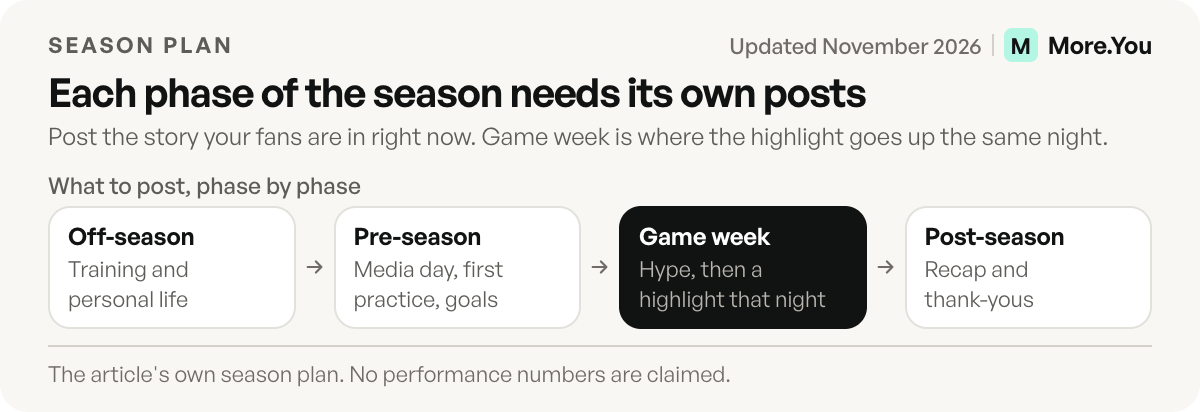
Your season already sets the calendar. Each phase gives fans a different story, so the posts change with it.
| Phase | What to post | Example posts |
|---|---|---|
| Off-season | Training and personal life | Workout clips, a new skill in progress, a day in your routine, a camp you coach |
| Pre-season | Build-up | Media day photos, the first practice, goals for the season, schedule announcement |
| Game week | Hype and the result | Countdown Story, pre-game routine, a highlight within hours of the final whistle, thanks to fans |
| Post-season | Reflection and what’s next | Season recap, best moments, a thank-you to teammates and coaches, sponsor recap |
Three habits make the plan work:
- Post the highlight the same night. The game is the moment fans search for you. A clip posted three days later competes with everything else in their feed.
- Show the work as well as the wins. Losses, injuries and rehab are the posts that make fans care about the next win. Share what you are comfortable with and keep medical details private.
- Credit the team. Tag teammates, coaches and the club. Their audiences see the post, and nobody likes a feed that is only about one player.
Inside each phase, fix one posting day for training clips and one for game content, so you never decide from blank.
How do athletes make money on social media?
Athletes earn from social media through paid posts, affiliate codes, appearances and their own products such as camps and lessons. In college, that is NIL: name, image and likeness. The NCAA’s interim policy has allowed it since July 1, 2021 (cbssports.com, June 2021).
The House v. NCAA settlement, approved on June 6, 2025, added revenue sharing on top: schools could share up to $20.5 million with athletes in 2025-26, the first year (thescore.com, June 2025). Third-party NIL deals from brands and local businesses still run through your own accounts.
Three income routes work at any follower count:
- Local sponsors. A gym, restaurant or car dealer near your school pays for a post, an appearance or a discount code.
- Affiliate codes. Gear and supplement brands give you a code and pay a share of each sale.
- Your own offers. Private lessons, camps and signed items, booked or sold from your bio link.
Brands ask for your audience size, engagement and past results before they pay. A one-page media kit answers those questions before they ask.
What rules apply to athletes’ paid posts?
Every paid post needs a clear disclosure, and college and Olympic athletes have extra rules on top. Check these before you sign:
| Rule | Who it applies to | What it says |
|---|---|---|
| FTC endorsement disclosure | Anyone in the US posting paid content | Put “ad” or “sponsored” in the post itself, not only in the bio or behind “more”. The platform’s paid-partnership label alone is not enough (ftc.gov) |
| NIL Go reporting | NCAA Division I athletes | Report third-party NIL deals of $600 or more, including smaller deals from one payer that add up to $600. Incoming athletes report within 14 days of starting full-time classes or before their first game, whichever comes first (College Sports Commission, October 2025) |
| High school NIL | High school athletes | NCSA counts about 45 states plus D.C. that allow some form of it as of October 2026 (ncsasports.org). Other trackers count between 41 and 46, and rules differ by state, so check your state association first |
| IOC Rule 40 | Olympians during the Games period | At Milano Cortina 2026: one simple thank-you post per personal sponsor that was not an Olympic partner (IOC Rule 40 FAQ, June 2025) |
Federal NIL law was still open when the House’s SCORE Act stalled again in May 2026 (rollcall.com, May 2026). Until Congress passes one, the NCAA and state rules above are the ones that apply.
How should athletes set up their bio and link?
Your bio answers three questions in a few words: what sport and position, which team, and what to tap. Add your class year if you are a recruit. Then your one link carries everything that does not fit. For copy-paste versions by sport and level, see these athlete bio templates.
Every phase of the season sends fans to the same link, so build it once and change the top. A good athlete bio page holds:
- Next game or event at the top, with date, venue and a ticket or stream link.
- Highlight reel on YouTube, for fans and for coaches.
- Sponsor codes, each as its own labeled link.
- Camps and lessons, with a booking link.
- Media kit and contact for brands and press.
- Every social profile in one row.
On More.You, event blocks hold the schedule and generate Event structured data, so search engines and AI assistants can read the date and venue. Product and booking blocks cover merch, camps and lessons. The full list of blocks is on the features page. The general setup is in what a link in bio is.
Social media for sports teams and clubs
Sports team social media follows the same season plan with a wider cast. One person owns the club account, and a short rota of coaches or parents covers game days. Each game week repeats the same posts, so the account never goes quiet and the bio link always points at the next thing fans need.
| When | Club post | Top of the bio link |
|---|---|---|
| Schedule release | Full fixture graphic, pinned to the profile | Fixture list with dates and venues |
| Early in game week | Player or coach spotlight | Tickets or stream for the next game |
| Day before | Line-up or travel post | Next game: date, venue, start time |
| Game day | Countdown Story, score updates that tag the players | Tickets or stream |
| After the final whistle | Final score and one highlight the same night | Highlight reel |
| Bye week or off-season | Training, behind the scenes, sponsor thanks, registration open | Registration form, club shop |
Ask players to share club posts from their own accounts, so each post reaches their followers too.
Agree on the rules before the first post. TrueSport’s guidance for coaches, republished by USA Volleyball, says to decide the team’s social media plan at the start of the season and to check that each athlete is comfortable before you share their image. For youth teams, get written permission from parents before posting minors, and never post a child’s school or home location.
Keep the club’s bio link on the fixture list, tickets or streams, the registration form, the club shop and a row of sponsor links. Add a booking block for trials or camps.
Mistakes athletes make on social media
Most problems come from the same few habits. Each has a fix you can apply before the next post.
| Mistake | Fix |
|---|---|
| Posting live from the venue, the hotel or home | Post after you leave, and keep your home and school location out of the post |
| Sharing injury or medical details | Share the work you are comfortable with, and keep medical details private |
| A paid post with the disclosure only in the bio | Put “ad” or “sponsored” in the post itself |
| Signing a deal without checking the rules | Check your league, school and state rules first, and report deals where the rules ask |
| One account for sport, school and private life | Keep the public account to sport, and set private accounts to private |
One link for the whole season
Fans come from game-day posts, scouts come from the highlight reel and sponsors come from the media kit. All of them land on the same link. Create your More.You page for free, put the next game at the top, and change it once a week. On Pro, Auto-Pin can pin each scheduled post’s link to the top for you.
Every More.You page also has a QR code. Print it on a poster, a camp flyer or a ticket, and people at the venue reach the same page with one scan. How to make an Instagram QR code covers where to place a code so people scan it.
FAQ
What should athletes post on social media?
Post training clips and personal routines in the off-season, build-up in pre-season, hype and a same-night highlight in game week, and a recap after the season. Mix wins with work and setbacks, and tag teammates and coaches.
Which social media platform is best for athletes?
Instagram works as the main account for most athletes, because it covers highlights, Stories and sponsor posts. Add TikTok for reach or YouTube for full highlight reels. Recruits benefit from YouTube, where a full highlight reel lives at one stable link.
Do college athletes have to report NIL deals?
In NCAA Division I, yes. Athletes report third-party NIL deals of $600 or more through NIL Go, including smaller deals from one payer that add up to $600. Missing a report can put eligibility at risk.
Do athletes have to say a post is sponsored?
Yes. In the US, the FTC expects a clear disclosure such as “ad” or “sponsored” in the post itself. The platform’s paid-partnership label alone is not enough.
Can high school athletes make money from social media?
In most states, yes. NCSA counts about 45 states plus D.C. that allow some form of high school NIL as of October 2026, and other trackers count between 41 and 46. Rules differ by state, so check with your state athletic association before you sign anything.
Sources
- biz.opendorse.com, Opendorse, NIL at Four: Monetizing the New Reality, July 2025
- deloittedigital.com, Social media strategies for sports, November 2025
- cbssports.com, NCAA approves interim NIL policy, June 2021
- thescore.com, House v. NCAA settlement approved, June 2025
- College Sports Commission, What you need to know about NIL deals, October 2025
- ncsasports.org, High school NIL by state, October 2026
- rollcall.com, House NIL bill gets benched, May 2026
- ftc.gov, Disclosures 101 for Social Media Influencers
- usavolleyball.org, TrueSport, Nine social media dos and don’ts for healthy team culture, accessed November 2026
- IOC Rule 40 FAQ, Milano Cortina 2026, June 2025
- Instagram Help, add a website to your Instagram profile, checked November 2026
- support.google.com, YouTube channel links, accessed November 2026
- TikTok Support, links in a TikTok profile, accessed November 2026
- More.You feature pages: more.you/features/bio-page-blocks, more.you/features/ai-native-pages and more.you/features/auto-pin (November 2026)