YouTube does not pay a fixed rate per view, so how much it pays depends on the ads your videos show. It shares ad revenue with creators in the YouTube Partner Program: 55% on long-form videos and 45% on Shorts. Across 300 monetized channels, the median creator earned $2.30 per 1,000 views, about $0.0023 per view. The niche medians ran from $0.33 in kids’ content to $10.22 in education.
So 100,000 views on a long-form video earn the median channel about $230. The same views on Shorts earn a fraction of that. And none of it arrives until your channel meets the Partner Program bar, which YouTube raises for new applicants on 1 February 2027.
This guide shows what a view is worth in 9 niches, how Shorts pay, who qualifies in 2026 and 2027, and the views it takes to earn $1,000. It ends with the comparison most rate tables skip: how many views one product sale is worth.
Key Takeaways
- YouTube pays per ad, not per view. Creators keep 55% of net ad revenue on long-form videos and 45% of their allocated Shorts revenue.
- The median RPM is $2.30. That is about $0.0023 per view, or $230 per 100,000 long-form views.
- Niche moves the rate 31x. Education and science channels earned a median $10.22 per 1,000 views; kids and teens channels earned $0.33.
- Shorts pay far less per view. Shorts RPM ran at 3% to 14% of long-form RPM in almost every niche.
- The bar rises in 2027. From 1 February 2027, new channels need 8,000 watch hours or 20 million Shorts views to join the Partner Program.
How much does YouTube pay per view?
In a study of 300 monetized channels, the all-channel median was $2.30 per 1,000 long-form views, or $0.0023 per view, and niche medians ran from 0.03¢ to 1.02¢ per view. To estimate your own pay per view, divide your RPM by 1,000. To estimate a video’s earnings, multiply your RPM by its views and divide by 1,000.
RPM is the number to use. YouTube defines RPM as the money you earned per 1,000 views, calculated after YouTube’s revenue share, and it includes ads, channel memberships, YouTube Premium revenue, Super Chat and Super Stickers (YouTube Help, checked November 2026). CPM is a different number: what advertisers spend per 1,000 ad impressions, before YouTube’s cut. Quoting CPM as pay mixes up two different numbers.
Two things separate what advertisers pay from what you earn per view. YouTube keeps its share (45% on long-form ads), and many views never show an ad. The median channel in AIR Media-Tech’s study monetized 53% of its views (AIR Media-Tech, May 2025 to May 2026 data).
YouTube pay per view by niche
The table uses the median long-form RPM per niche from AIR Media-Tech’s study of 300 monetized channels, from 10,000 to 50 million subscribers. The earnings columns are our arithmetic on those medians. Niches with fewer than ten channels in the study (Transport, News and Politics, Food and Cooking, Business and Finance) are left out.
| Niche | Median RPM | Per view | 100,000 views | 1 million views | Views to earn $1,000 |
|---|---|---|---|---|---|
| Education and science | $10.22 | 1.02¢ | $1,022 | $10,220 | about 98,000 |
| Lifestyle | $2.98 | 0.30¢ | $298 | $2,980 | about 336,000 |
| Entertainment | $2.43 | 0.24¢ | $243 | $2,430 | about 412,000 |
| Crafting and handmade | $2.39 | 0.24¢ | $239 | $2,390 | about 418,000 |
| Gadgets and tech | $2.33 | 0.23¢ | $233 | $2,330 | about 429,000 |
| All channels (median) | $2.30 | 0.23¢ | $230 | $2,300 | about 435,000 |
| Music | $2.28 | 0.23¢ | $228 | $2,280 | about 439,000 |
| Gaming | $2.05 | 0.21¢ | $205 | $2,050 | about 488,000 |
| Health and sport | $1.23 | 0.12¢ | $123 | $1,230 | about 813,000 |
| Kids and teens | $0.33 | 0.03¢ | $33 | $330 | about 3.03 million |
A median hides a wide spread. In education and science, the middle half of channels earned between $2.31 and $19.50 per 1,000 views, so your channel can sit far from its niche median in either direction.
How much do YouTube Shorts pay per view?
Shorts pay far less per view than long-form videos. YouTube pools ad revenue from the Shorts feed each month, allocates a creator pool by engaged views and music use, and creators keep 45% of their allocated revenue (YouTube Help, checked November 2026). In AIR Media-Tech’s 274-channel study, Shorts RPM was 3% to 14% of long-form RPM in almost every niche.
In that study, most niches earned $0.07 to $0.20 per 1,000 Shorts views, and US viewers earned $0.328 per 1,000 (AIR Media-Tech, updated September 2026). At those rates, 1 million Shorts views pay roughly $70 to $200, and about $328 from a US audience. Music was the exception, at 41% to 60% of its long-form rate.
From 1 February 2027, a channel needs at least 10 million qualified Shorts views in the last 90 days to earn a share of Shorts ad and Premium revenue. Channels below that line stay in the Partner Program and keep earning on long-form videos (YouTube Official Blog, 10 August 2026).
Who gets paid: Partner Program rules for 2026 and 2027
YouTube shares ad revenue only with channels in the YouTube Partner Program. Today, a channel qualifies with 1,000 subscribers plus either 4,000 qualified watch hours in the last 12 months or 10 million qualified Shorts views in the last 90 days (YouTube Help, checked November 2026).
| Rule | Until 31 January 2027 | From 1 February 2027 |
|---|---|---|
| Long-form route to join | 4,000 watch hours in 12 months | 8,000 watch hours in 365 days |
| Shorts route to join | 10 million Shorts views in 90 days | 20 million Shorts views in 90 days |
| Share of Shorts revenue | Every monetized channel | Channels with 10 million Shorts views in 90 days |
| Long-form ad share | 55% | 55% |
| Shorts revenue share | 45% | 45% |
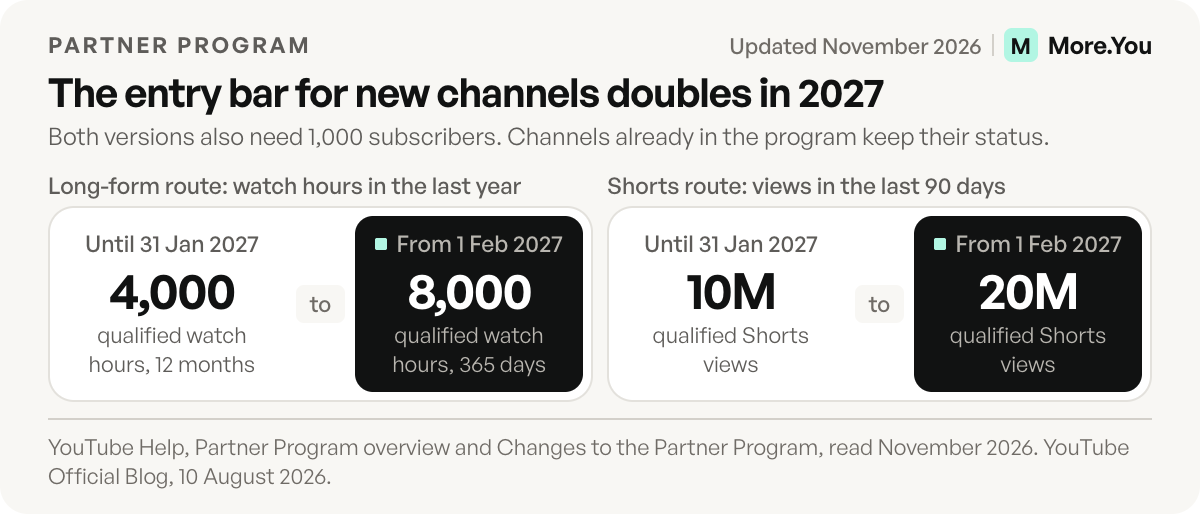
YouTube says the higher entry bar does not affect creators already in the program. Existing partners still need to accept the updated terms in YouTube Studio by 31 January 2027 to keep full monetization. The same update adds Shorts ads that an advertiser targets at five or fewer channels, where eligible creators earn a direct 45% revenue share (YouTube Help, checked November 2026).
Why YouTube pay per view figures disagree
Rate guides online quote different numbers because they measure different things. RPM is what you earn per 1,000 views after YouTube’s share. CPM is what advertisers pay per 1,000 ad impressions before that share. A third figure, pay per ad view, is a different unit again. A guide that quotes a CPM as your pay will look two or three times too high.
Check the share too. YouTube’s own post of 10 August 2026 states 55% for long-form videos and 45% for Shorts (YouTube Official Blog). A guide that uses a different split may be using an older figure. When a number has no stated method, treat it as a guess. This article uses one study with a stated method, and the YouTube pages for every rule.
YouTube early-access, activity and Premium rules from 2027
YouTube’s page on changes to the Partner Program lists three more points that matter if you earn from more than ads (YouTube Help, read November 2026).
- Early tier unchanged. Fan funding, YouTube Creator Partnerships and YouTube Shopping stay open at 500 subscribers plus either 3,000 qualified watch hours in the last year or 3 million qualified Shorts views in the last 90 days. This tier does not share ad revenue.
- Activity rule. From 1 February 2027, a channel counts as active with any one of: 1,000 qualified watch hours in 365 days, 1 million qualified Shorts views in 90 days, or 2 long-form videos or 5 Shorts uploaded every 90 days.
- Premium pools. Creators share a pool of 60% of net subscription revenue for Premium Lite views and 30% for Premium views.
For a creator with 500 subscribers, the first point means a link to a product or a sponsor page is worth building before ad revenue starts.
What changes how much a view earns
Four factors set your RPM:
- Niche. Education and science channels earned 31 times the kids and teens median in the same study.
- Share of views that show an ad. The median channel monetized 53% of its views. In gadgets and tech it was 34%, which pulled a high-CPM niche down to a $2.33 RPM.
- Audience country. Ads cost more in some markets. In the Shorts study, US audiences earned creators $0.328 per 1,000 views against $0.163 in Germany.
- Format. Long-form views pay many times more than Shorts views, so a channel’s mix of formats sets its blended rate.
Check the RPM card in YouTube Studio’s revenue tab for your real number, and treat any niche table, including this one, as a starting estimate.
What one sale is worth in YouTube views
A quick way to see the limits of ad revenue is to price a sale in views. The table below takes three product prices, subtracts Gumroad’s 10% + $0.50 fee per direct sale (gumroad.com, checked November 2026), and converts what is left into views at the $2.30 long-form median and the $0.328 US Shorts rate.
| One sale of | You keep | Long-form views to earn the same | US Shorts views to earn the same |
|---|---|---|---|
| $9 template | $7.60 | about 3,300 | about 23,000 |
| $29 preset pack | $25.60 | about 11,100 | about 78,000 |
| $99 course | $88.60 | about 38,500 | about 270,000 |
One preset pack sale equals about 11,100 long-form views of ad revenue. Example: if 1,000 viewers tap your link and 1% buy that $29 pack, the 10 sales keep $256, the same as about 111,000 long-form views at the median rate. That only works when the link leads somewhere that sells: a product, a booking, a sponsor page or a mailing list.
Where the rest of your YouTube income comes from
More.You is an AI-native link in bio platform. One page holds product, booking and event blocks, and Free analytics show views, clicks and click-through rate for each block.
Ad revenue is one line in a YouTube creator’s income. The others (products, sponsors, affiliate links, coaching calls) all need a link, and YouTube gives you a few places to put one: channel links, long-form video descriptions and pinned comments. Our guide on where to put links on YouTube covers each placement, including the clickable route out of a Short.
Point those links at one page instead of five. A bio page with product and booking blocks lets a viewer buy your template, book a call or open your sponsor’s offer from the same tap. Our guide to tracking link in bio clicks shows how to see which video sent each click. If you have not built a product yet, our list of digital products to sell has 12 ideas with what each keeps per sale.
Relying on one platform’s payout carries its own risk, as rules like the 2027 changes show. Our piece on platform payouts and an audience you own looks at that trade-off.
Turn your channel link into income
Put a product block and a booking block on one page, and add that page as your first channel link and in every long-form description. Free analytics then show which block your viewers click. Create your More.You page and give each view a second way to earn.
FAQ
How much does YouTube pay per 1,000 views?
The median monetized channel earned $2.30 per 1,000 long-form views in a study of 300 channels. Niche medians ranged from $0.33 for kids and teens content to $10.22 for education and science. Shorts earned far less, mostly $0.07 to $0.20 per 1,000 views.
How much does YouTube pay for 1 million views?
At the median RPM of $2.30, 1 million long-form views earn about $2,300. An education channel at its niche median would earn about $10,220, and a kids channel about $330. One million Shorts views earn roughly $70 to $200 in most niches.
Does YouTube pay you for views before you join the Partner Program?
No. YouTube shares ad revenue only with channels in the YouTube Partner Program. Today you need 1,000 subscribers plus 4,000 watch hours in 12 months or 10 million Shorts views in 90 days. From 1 February 2027, new applicants need 8,000 watch hours or 20 million Shorts views.
How many views do you need to make $1,000 a month on YouTube?
At the $2.30 median RPM, you need about 435,000 long-form views a month to earn $1,000 from YouTube revenue. An education channel at its niche median needs about 98,000 views. A channel earning mostly from Shorts needs millions of views for the same amount.
Do YouTube Shorts pay as much as long-form videos?
No. Shorts RPM was 3% to 14% of long-form RPM in almost every niche in a 274-channel study. Creators keep 45% of their allocated Shorts revenue, against 55% of net ad revenue on long-form videos.
Sources
- YouTube Help: YouTube Partner Program overview and eligibility (checked November 2026)
- YouTube Help: YouTube Shorts monetization policies (checked November 2026)
- YouTube Help: Understand RPM and CPM (checked November 2026)
- YouTube Official Blog: YouTube Partner Program updates for 2027 (10 August 2026)
- YouTube Help: Changes to the YouTube Partner Program (checked November 2026; new-creator thresholds from 1 February 2027)
- AIR Media-Tech: YouTube RPM in 2026, real data from 300 channels (updated July 2026)
- AIR Media-Tech: YouTube Shorts RPM vs long-form, data from 274 channels (updated September 2026)
- Gumroad pricing: direct sale fees (gumroad.com, checked November 2026)
- More.You blocks and analytics: more.you/features/bio-page-blocks and more.you/features/analytics-attribution (November 2026)
Platform rules and prices checked November 2026.